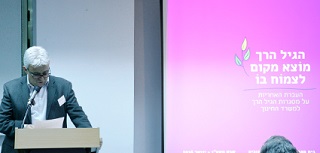
Is it possible to improve the quality of Israel’s early childhood education frameworks, and if so, how? And what would the Ministry of Education have to do to be prepared for a possible transfer of responsibility for early childhood frameworks from the Ministry of the Economy? At the request of the Ministry of Education, the fellows of the Mandel School for Educational Leadership’s 23rd cohort explored these questions in this year’s group exercise. At the end of the exercise, the fellows presented a document titled “Early Childhood Education Finds Room to Grow” at an event held at the school at the beginning of February.
The cohort 23 fellows examined three central aspects of early childhood education: the state’s responsibility and role regarding preschool children; early childhood needs and the quality of the public services currently provided; and organizational and professional aspects of the current system and the expected transition. To complete the picture, a brief review was conducted of the legal and budgetary aspects of the issue.
As part of this work, the fellows conducted a comparison of Israel’s early childhood daycare centers to other OECD countries. “Early childhood education (from birth to three years) in Israel has for years been the responsibility of the Ministry of the Economy, based on the idea that daycare centers were a means of removing barriers to women’s involvement in the labor market… The possible transfer of responsibility for early childhood education to the Ministry of Education provides a good opportunity for a re-evaluation of the objectives that guide policy in this area,” they wrote in the report.
The main claim made by the document is that, given the large socioeconomic gaps in Israel and the critical importance of early childhood for long-term individual development, there needs to be real investment in providing equal opportunities. The report therefore recommends prioritizing the improvement of the quality of early childhood daycare centers and educational frameworks, and selectively promoting access to these institutions among vulnerable populations, using socioeconomic criteria.
Moshe Vigdor, the director-general of the Mandel Foundation–Israel, opened the evening with congratulatory remarks to the cohort 23 fellows and to the school’s faculty, and also conveyed the best wishes of the chairman of the Foundation, Mr. Morton Mandel, and of its president, Prof. Jehuda Reinharz.
“Your decision to examine the question of early childhood frameworks
through the lens of one of our society’s biggest problems - social
inequality - is a values-based decision, rooted in a world view that sees
the state and the public education system as having full responsibility
for reducing socioeconomic gaps and creating a more just society,” said Danny Bar Giora,
director of the Mandel School for Educational Leadership. “You then
succeeded in translating this world view into practical recommendations…
This connection between vision and practice is the entire ‘Mandelian’
approach in a nutshell,” he said.